
Dark fiber
IRU or lease on dedicated strands, conduit and innerduct, and spectrum on our line system for your own optics.
Fiber capacity solutions
Dark fiber, lit services and multi-carrier interconnection, designed route by route and delivered under one SLA.
Solutions
The same route sells two ways: dark fiber on the corridors you expect to fill, and lit services everywhere else.
IRU or lease on dedicated strands, conduit and innerduct, and spectrum on our line system for your own optics.
Waves from 10G to 800G, protected or unprotected, between your campus and the facilities it needs.
Ethernet private line and Ethernet virtual private line, point to point or across several sites.
Dedicated internet access and IP transit, delivered on the same route as your other services.
Rack space in our huts and in carrier-neutral facilities, on A and B power feeds, with cross-connects and remote hands.
Route design, permitting, OSP construction, ILA huts, splicing and acceptance testing, with bonded Texas contractors.
Lit services are provided on YAXYS routes as they enter service, directly or through certificated partners.
Capacity
Capacity on a fiber route is not one number. It is a ladder: what one channel carries, what a channelized pair carries, and what the whole cable holds when the rest of it is lit. A YAXYS route is designed so you climb that ladder without a second build.
| Level | What it is | Design capacity |
|---|---|---|
| One channel | A single wavelength on one pair | 100G, 400G or 800G |
| One pair, C-band | 64 channels at 400G | 25.6 Tb/s |
| One pair, C+L | About 128 channels at 400G | About 51 Tb/s |
| 288-fiber cable | 144 pairs, C-band at 400G | 3.7 Pb/s |
| 864-fiber cable | 432 pairs, C-band at 400G | 11.1 Pb/s |
| 1,728-fiber cable | 864 pairs, C-band at 400G | 22.1 Pb/s |
Design capacity, not deployed capacity, at 400G per channel on a 75 GHz grid2. A faster line rate alone does not raise it: 800G on 150 GHz also gives 25.6 Tb/s per C-band pair6; better spectral efficiency does, as with 1.6T on 200 GHz at 38.4 Tb/s4, and so does adding the L-band. The route sizer below starts at 8 lit pairs, an assumption; set it to your route.
On dedicated strands the fiber is yours: your traffic never touches another customer’s line system, there is no shared capacity to contend for, and you choose the equipment that lights it. We hand off at your demarcation and maintain the plant underneath.
IRU or lease, with defined splice points and demarcation on your ODF.
Light the strands with your own transponders, or run 400ZR and ZR+ pluggables as alien waves on our line system under a spectrum service.
Available on managed waves, for traffic that has to stay encrypted in flight.
Connect your own sites without transiting a shared public network.
On dark fiber and spectrum, add channels on your own schedule, with no order to place and no interval to wait out.
Capacity tools
Coherent optics now carry 1.6 Tb/s on a single wavelength4, and a 1.6 Tb/s wave has run in a live-network trial on an operator’s existing 470 km route9. These tools show where each optics generation puts a fiber pair and a full cable, and how distance sets the rate.
| 10G wave1 | 10 Gb/s |
|---|---|
| 400G wave2 | 400 Gb/s |
| 1.6T wave3 | 1.6 Tb/s |
| One pair, C+L4 | 76.8 Tb/s |
| 288-fiber cable5 | 11.1 Pb/s |
| 1,728-fiber cable5 | 66.4 Pb/s |
Logarithmic scale. The pair and cable rungs are calculated, not measured, on an assumption: every pair lit at 1.6 Tb/s on 200 GHz slots, 48 channels in the 9.6 THz of a conventional C+L line system10, a rate Ciena states for metro networks3.
| Optic generation | Reach |
|---|---|
| 1.6T | Metro networks3; a live-network trial over 470 km9 |
| 1.2T | About 100 km in 150 GHz8 |
| 800G | Up to 120 km as an 800ZR pluggable6; long-haul networks of over 2,000 km7 and the longest links3 |
| 400G | Up to 120 km as a 400ZR pluggable2 |
The same optic runs faster on a shorter span and slower on a longer one3, so the rate a given route carries depends on its length and the optics at each end. We specify the optic generation and reach for each route at the client’s request.
Illustrative design figures: design capacity, not deployed capacity. Rates and slot widths: 400G on 75 GHz2, 800G on 150 GHz6, 1.2T on 150 GHz7, 1.6T on 200 GHz4. Spectrum: conventional C+L line systems offer 9.6 THz, 4.8 THz in each band, and extended C and L bands reach 10.8 to 12 THz10; the sizer uses 9.6 THz, so channels per pair are 9.6 THz divided by the slot width. Cable sizes are standard ribbon-cable counts5. Pick any generation to see its capacity; the rate a given route carries depends on its length (Distance sets the rate, above), fiber and optics. Faster optics lower cost and power per bit3; the ceiling on each pair is set by the spectrum it carries and the reach it must cover8.
Network
One fiber pair can carry more than any single carrier hotel can take in. Cloud on-ramp ports top out at 400 Gbps, each cloud’s on-ramps sit in different buildings, and no operator will accept one building as a single point of failure. At hyperscale, reaching the cloud means landing in several facilities, not one.
So we place the optical terminal in a YAXYS site near the campus and deliver structured handoffs into each carrier hotel. Your footprint in each building drops to a patch panel and cross-connects, and your capacity is set by your fiber, not by someone else’s floor space.
So capacity is planned in three layers: what the cable holds, what the lit pairs carry, and what each building can take. We design all three together, so the campus is never limited by the handoff at one carrier hotel.
Route diversity
Large campuses usually sign one or two national carriers for their primary long-haul routes. Those routes often share corridors, bridges and river crossings, so one event can cut both.
YAXYS builds the physically separate path: its own right-of-way, its own huts and splice points, owned and maintained by one company and specified before it is sold.
Interconnection
From the fastest to set up to the widest reach. We handle the LOA and CFA, ASR, FOC tracking and acceptance testing across carriers, so you do not coordinate the handoffs.
A jumper between our rack and another carrier’s in the same building, in place in days.
A standing lit handoff at 10G, 100G or 400G, with circuits ordered against it.
A documented splice in a handhole or hut that extends dark fiber past our own footprint.
Another carrier’s circuit, wrapped in our SLA and delivered as one end-to-end service.
Why YAXYS
We own what makes sense to own, lease the rest at meet-me points, and deliver one circuit under one SLA: one contract, one bill, one number to call.
Fresh fiber and a documented span design for 400G and 800G, so capacity grows on the same glass.
Start on waves, move to dark fiber as volume grows, and keep the same provider either way.
A route attestation delivered with the as-built package: KMZ, strip maps, splice diagrams and OTDR traces.
Our operating standard
From the first day of service.
FAQ
We design each route on its own right-of-way, huts and crossings, apart from the carriers already serving your campus, and document the separation in a written route attestation delivered with the as-built package.
Yes. On dark fiber you light the strands with your own equipment; with spectrum service, your ZR and ZR+ pluggables run as alien waves on our line system, within the span design.
Yes. Start on waves and move to dark fiber on the same route as volume grows, without changing providers.
Each route carries a documented growth path: fiber type, span length and amplifier placement are set so the same fiber moves from 100G to 400G, and to 800G per channel where the span supports it, without a new build.
Each route is designed to the campus; common builds run 288 to 1,728 fibers.
A single channelized pair carries 25.6 Tb/s in the C-band at 400G per channel2. 800G on 150 GHz carries the same6; 1.6T on 200 GHz raises it to 38.4 Tb/s where the span supports that rate, and adding the L-band roughly doubles the spectrum4. An 864-fiber cable holds 432 pairs, so its design capacity runs past 11 Pb/s. Size for the pairs you need now; the route sizer shows what the remaining pairs would add.
Dedicated strands, no shared line system, and your choice of optics. Your traffic does not contend with another customer’s, and capacity changes are yours to make rather than an order to place.
Terminating an 864-fiber cable takes about one cabinet per end and draws no power. A lit route typically runs one to three cabinets at 2 to 25 kW, depending on how many pairs are in service.
Yes. We build the laterals to the nearest regional ISPs and carriers and the long-haul route to the metro as one project, in Texas and neighboring states.
Permitting, railroad and highway crossings, make-ready and long-lead equipment; we plan them in route design and report against milestones.
Team
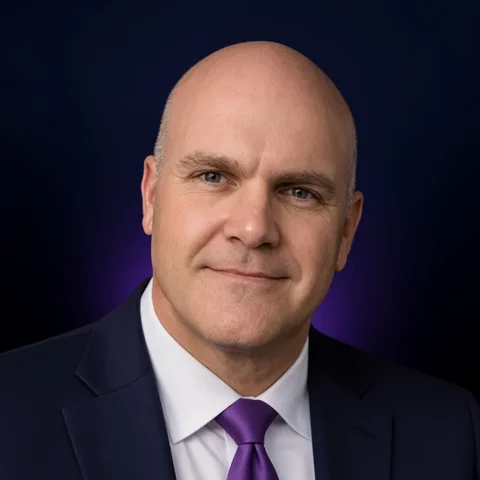
President, CEO & Co-Founder
10+ years of industry experience
Decades of executive leadership spanning commercial banking, infrastructure construction, PMO, and private capital. Experience serving some of the world’s leading organizations, including SpaceX, ExxonMobil, Google, and BP.

Co-Founder
Operations, finance and systems
Senior software engineer with an energy-sector background. Runs operations, finance and the systems behind YAXYS route design, from first desktop study through delivery.
Headquartered in Texas. We build across Texas and into neighboring states, wherever a campus needs a path.